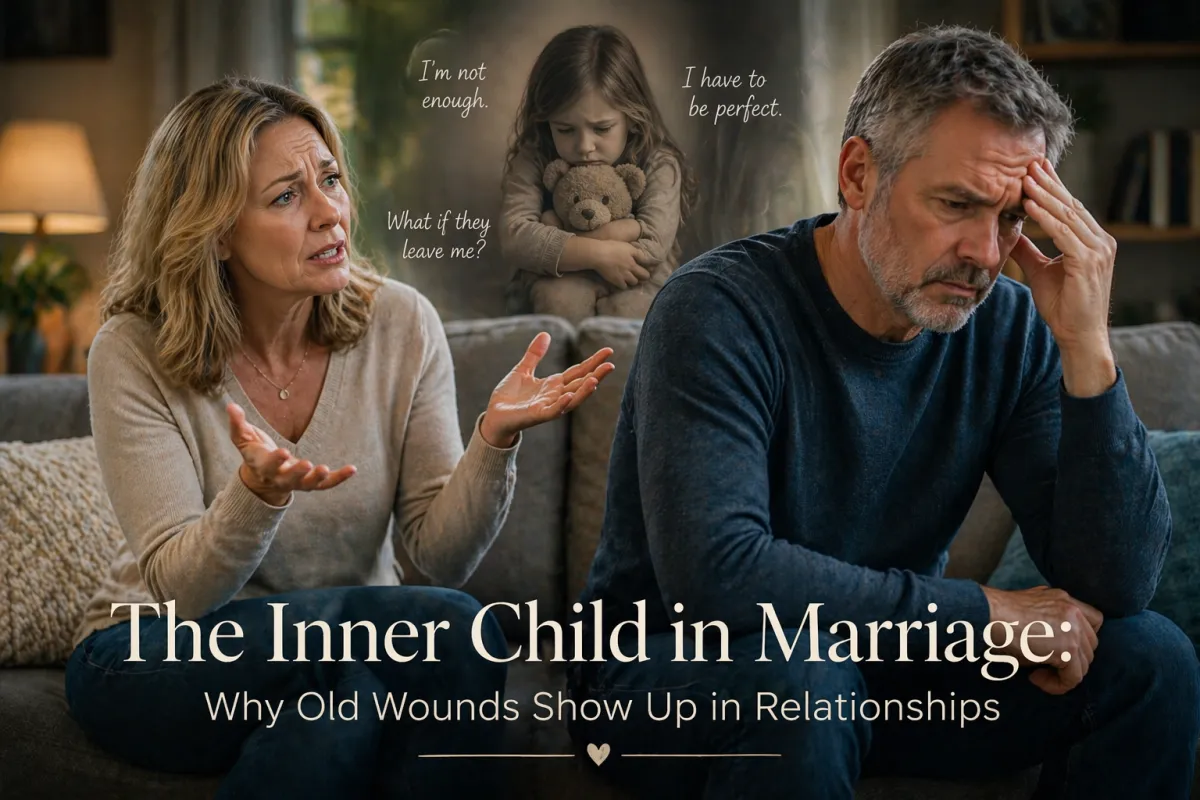
The Inner Child in Marriage
The Inner Child in Marriage: Why Old Wounds Show Up in Relationships
Have you ever had a moment in an argument where your reaction felt bigger than the situation itself?
Maybe your partner forgot something important or said something that came across as dismissive, and suddenly you felt deeply hurt, rejected, or misunderstood. Not just mildly annoyed—but emotionally activated in a way that felt intense, almost disproportionate to what actually happened.
This is one of the most common dynamics I see in my work with couples. And more often than not, it has very little to do with what’s happening in the present moment.
It’s coming from something much deeper.
What Is the Inner Child?
Your inner child is the emotional part of you shaped by your earliest experiences of love, safety, rejection, and belonging. Long before you met your spouse, your brain was already forming beliefs about how relationships work and what it means to feel secure—or unsafe—with another person.
These lessons are not always conscious, but they are powerful. You may have learned that love has to be earned, that conflict leads to disconnection, or that expressing your needs isn’t safe. For some, it may have felt like people pulled away when you were upset, or that your emotions were too much for others to handle.
Those experiences don’t disappear just because you grow up, become successful, or enter into a committed relationship. They stay with you, often quietly influencing how you interpret your partner’s words, actions, and behaviors.
When Your Inner Child Gets Triggered
This is where things start to make more sense.
When your partner forgets something important, responds in a certain tone, or pulls away during a disagreement, your reaction isn’t just about that moment. Your nervous system is scanning for familiarity, and if something feels similar to a past experience, it reacts accordingly.
I see this all the time with couples. One partner feels dismissed, and suddenly it’s not just frustration—it’s hurt, anger, or even panic. The other partner withdraws, not because they don’t care, but because conflict feels overwhelming or unsafe based on their own past experiences.
What’s happening in those moments is not just a disagreement between two adults. It’s two emotional histories interacting at the same time.
And when that goes unrecognized, couples can get stuck in the same patterns over and over again.
Recognizing Your Triggers Without Blame
Understanding your inner child is not about blaming your past or excusing behavior. It’s about developing awareness so you can respond differently instead of reacting automatically.
When couples begin to recognize their emotional triggers, everything shifts. Instead of seeing their partner as the problem, they start to understand what’s being activated underneath the surface. This creates space for curiosity instead of defensiveness, and compassion instead of conflict.
I often encourage my clients to slow things down in these moments and ask themselves simple but powerful questions. What am I actually feeling right now? Why does this moment feel so significant? What part of me feels hurt, scared, or misunderstood?
These questions don’t weaken you—they strengthen your ability to respond with intention rather than emotion.
How This Shows Up in Real Relationships
In real life, this can look like one partner pursuing connection while the other pulls away, creating a cycle that feels frustrating for both people. One person may feel abandoned, while the other feels overwhelmed. Neither is wrong—but both are reacting from a deeper place they may not fully understand.
This is where so many couples get stuck. They focus on the surface-level issue—the words, the tone, the behavior—without realizing that the real driver is something underneath it all.
And until that deeper layer is understood, the same arguments tend to repeat.
There Is a Different Way Forward
The goal is not to eliminate emotional reactions altogether. The goal is to understand them so they don’t control you or your relationship.
When couples learn how to recognize their triggers, communicate what’s really going on underneath, and create emotional safety with each other, the entire dynamic begins to change. Arguments become less intense, communication becomes more honest, and connection starts to feel possible again.
This is a big part of the work I do with couples. We don’t just talk about surface-level communication—we look at the patterns, the emotional responses, and the blind spots that are driving disconnection. Because once you understand those pieces, you can finally start creating change that actually lasts.